Refrigeration Efficiency & Compressor Cycles
Unlike intermittent laundry equipment, domestic refrigeration represents an unyielding 8,760-hour baseline load on household electricity meters. Minor percentage shifts in thermal dissipation compound into hundreds of dollars across a standard decade-long service lifespan.
 THERMAL BENCHMARKING
1. The Geometry of Usable Volume vs. Insulation Thickness
When studying the pictogram icons at the lower half of a refrigeration label, consumers encounter two volume metrics measured in liters: the chilled storage compartment (typically calibrated to +4°C) and the frozen storage compartment (-18°C). Every liter of freezer volume demands roughly four times the electrical energy to maintain compared to a liter of fresh food space.
High-efficiency Class A and Class B refrigerators achieve their marks through advanced vacuum insulation panels (VIPs). Traditional polyurethane foam requires wall thicknesses of 60 to 75mm to achieve an acceptable R-value, restricting internal volume. Vacuum panels deliver superior thermal resistance at a fraction of the wall thickness, preventing heat ingress from humid ambient air into the chilled core.
2. Fixed-Speed On/Off Pumps vs. Digital Inverter Compressors
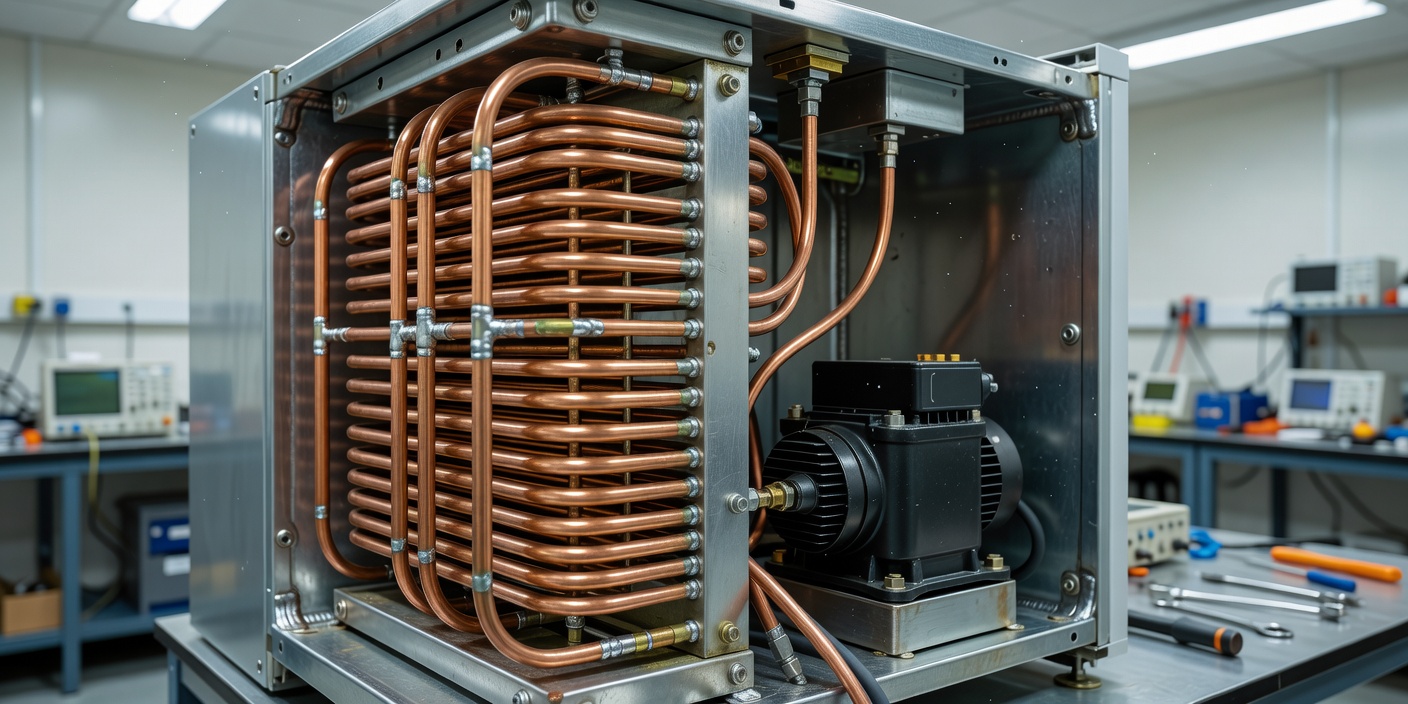
A conventional reciprocating compressor works on a crude binary principle: when the internal thermostat exceeds target thresholds, the motor engages at full speed until the cut-off point is reached. This starting surge creates significant electrical inrush current and mechanical wear.
Digital inverter compressors dynamically modulate their rotational velocity between 1,100 RPM and 4,300 RPM. When temperature is stable, the compressor idles at minimum draw, consuming fewer than 15 watts. This continuous gentle flow avoids thermal spikes, maintains humidity within produce crispers, and reduces acoustic noise to sub-35 dB(A) thresholds.
3. Decoding Climate Classes: SN, N, ST, and T
A refrigerator's stated kilowatt-hour rating is valid only when operated within its certified climate envelope. Operating an appliance outside its designated class causes dramatic efficiency collapse:
- SN (Subnormal): Ambient operation between +10°C and +32°C. Essential for unheated utility rooms or garages.
- N (Normal): Standard residential interior range between +16°C and +32°C.
- ST (Subtropical): Engineered for elevated ambients from +16°C to +38°C with expanded condenser coils.
- T (Tropical): Robust cooling circuits operating up to +43°C under high relative humidity.
4. Total No-Frost vs. Static Evaporator Coils
Total No-Frost technology eliminates ice buildup through forced air circulation over a concealed evaporator coil equipped with a timed electric defrost heater. While this eliminates tedious manual defrosting, the periodic heating cycle introduces an energy penalty of approximately 15% to 25% over static cold-wall cooling systems. A static freezer with 5mm of frost insulation on its walls, however, suffers an identical thermal penalty, demonstrating that regular maintenance is critical regardless of system architecture.
ESTIMATED 10-YEAR EXPENSE MATRIX (REFRIGERATION)
Tier A (105 kWh/yr) @ $0.22/kWh  =  $231.00 Total Electrical Outlay
Tier D (204 kWh/yr) @ $0.22/kWh  =  $448.80 Total Electrical Outlay
Tier F (310 kWh/yr) @ $0.22/kWh  =  $682.00 Total Electrical Outlay
----------------------------------------------------------------------
Net Savings Differential (A vs F) = $451.00 (Exceeds typical purchase gap)