Climate Control Seasonal Performance Factors
Air conditioners and reversible heat pumps feature the most structurally complex energy labels on the market. Rather than a flat annual estimate, performance is mapped against dynamic temperature fluctuations across three European climate zones.
 THERMAL COEFFICIENT VERIFICATION
1. SEER vs. SCOP: What Do the Multipliers Mean?
Energy labels for climate control display two core efficiency ratios:
- SEER (Seasonal Energy Efficiency Ratio): Evaluates space cooling performance across the entire summer season. An SEER of 8.5 means the unit delivers 8.5 kWh of cooling output for every 1.0 kWh of electricity consumed.
- SCOP (Seasonal Coefficient of Performance): Evaluates heating performance during colder months. An SCOP of 4.6 means the heat pump extracts 4.6 kWh of ambient thermal heat for every single unit of grid electricity.
2. The Three Continental Heating Zones
Because thermodynamic extraction becomes progressively more challenging as outdoor temperatures plummet toward sub-zero levels, European energy labels map heating SCOP across three geographic zones:
| Climate Zone | Reference Design Temp | Label Requirement | Real Operating Impact |
|---|---|---|---|
| Warmer Zone (Athens) | +2°C | Optional declaration | Minimal defrost cycling; exceptionally high SCOP (> 5.2) |
| Average Zone (Strasbourg) | -10°C | Mandatory baseline | Benchmark rating used for EU market classification |
| Colder Zone (Helsinki) | -22°C | Optional declaration | Requires supplemental resistive heating or enhanced vapor injection |
3. Sound Power Emissions: Indoor vs. Outdoor Units
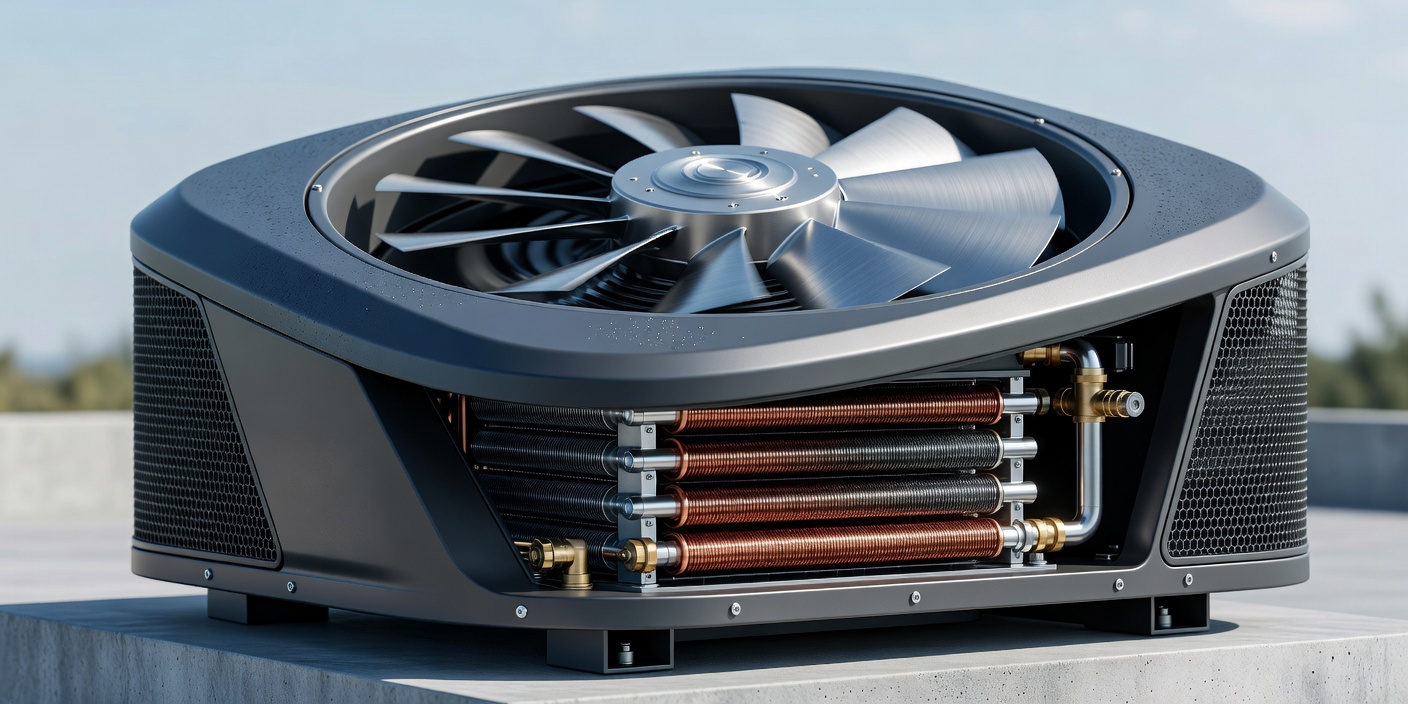
The label separates acoustic emissions into two distinct figures: the indoor evaporator unit (typically between 19 and 25 dB(A) in quiet mode) and the outdoor compressor fan (ranging between 52 and 65 dB(A)). Assessing outdoor acoustic levels is crucial to ensure compliance with municipal boundary noise ordinances during nighttime heating operation.
4. Inverter Modulation & Part-Load Realism
Older single-stage systems suffered heavy efficiency degradation due to continuous short-cycling. Modern inverter heat pumps throttle refrigerant mass flow smoothly via electronic expansion valves, operating at 20% capacity for 80% of their operational hours to maintain an ultra-stable thermal envelope.